
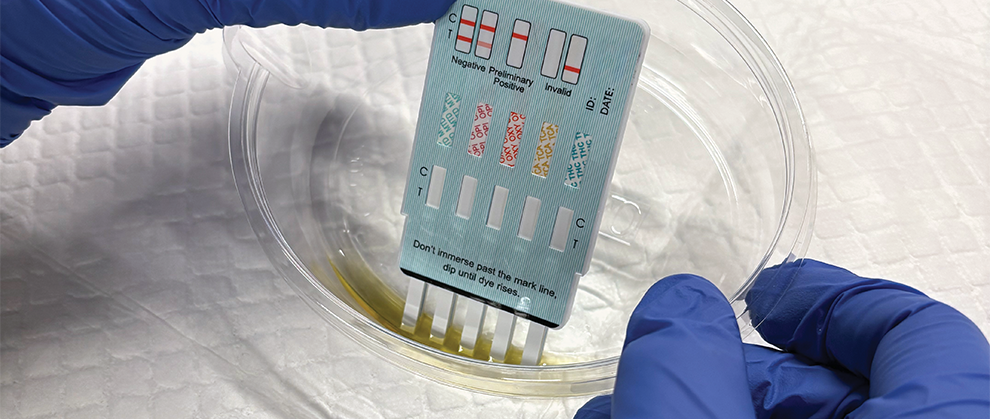
Over-the-counter drug tests are designed and marketed as screening tools to detect the presence of potentially intoxicating agents in human urine, but they can also be used for veterinary patients. These tests are cost efficient and provide results quickly, which is paramount when examining patients with clinical signs of intoxication. An understanding of how these tests work and how the results are interpreted, as well as an awareness of their limitations, is critical to their helpfulness with managing the care of veterinary patients.
Take-Home Points
- Over-the-counter urine drug tests are designed to screen for human drug use yet can be used for veterinary patients as well.
- Urine drug screening tests are immunoassays that use drug- or metabolite-specific antibodies to detect the presence of a drug.
- Veterinary patients metabolize some drugs differently from humans.
- Substances that interfere with urine drug test results are called adulterants.
- A negative test result does not rule out exposure. A positive test result may expedite necessary treatment for a patient with nonspecific clinical signs that are suggestive of intoxication.
Over-the-counter (OTC) drug tests are immunoassays that are designed to detect a certain level of drug or drug metabolite in human urine. These tests are available as immunoassays for single drugs and multiple drugs. No OTC urine drug tests are currently validated for veterinary patients, although some tests are sold with labeling that includes “vet” in the product name. This branding may lead to confusion, yet the package insert unequivocally states that these tests have been manufactured and approved for use as a screening test for humans and have not been validated for veterinary patients.1
How do OTC urine drug tests work?
OTC urine drug tests are reliable and easy to perform, providing results quickly with no additional equipment required. The tests are immunoassays that screen for the presence of drugs through antibody–drug and protein–drug conjugates.
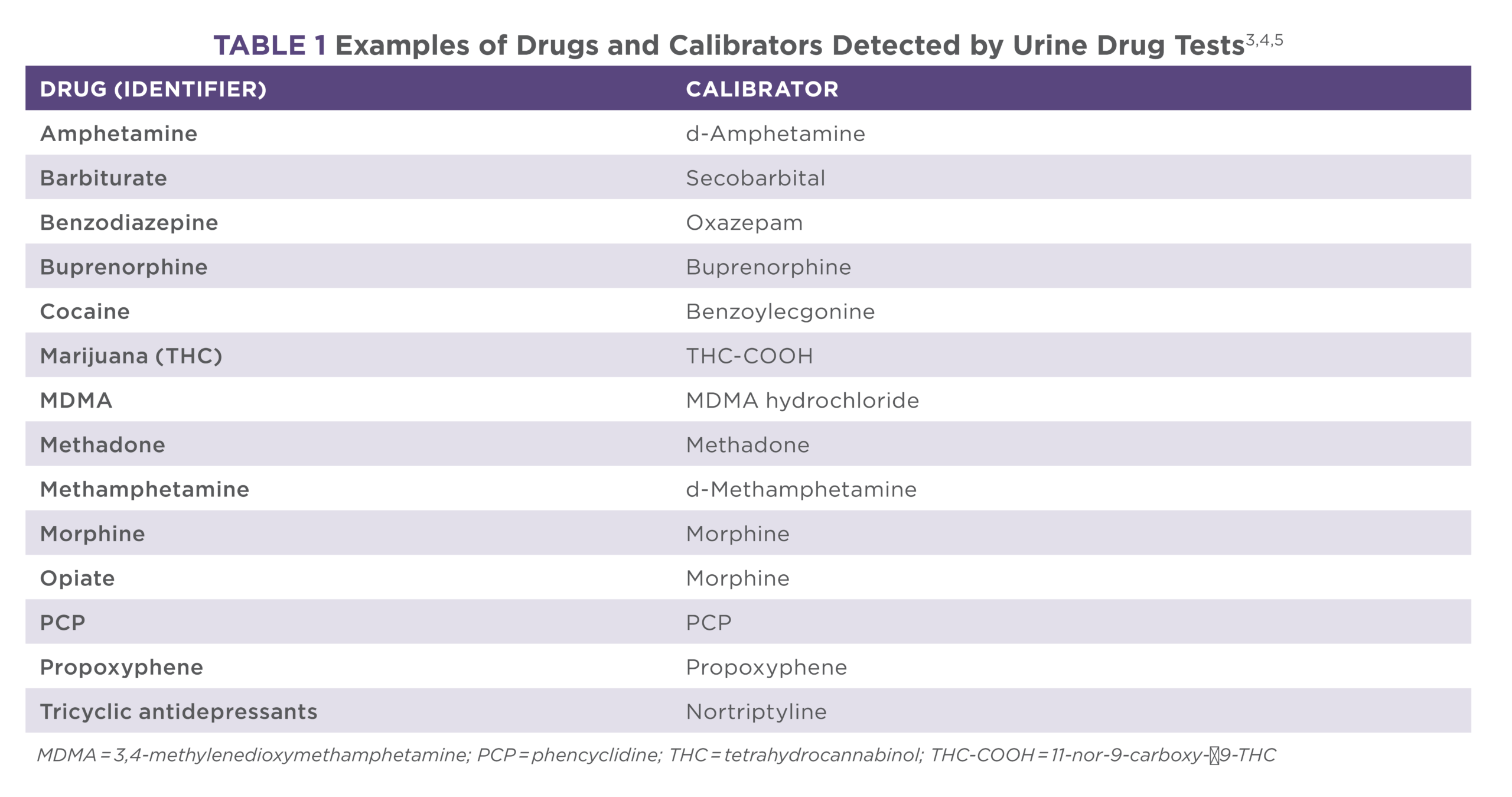
Drugs are called identifiers within the package insert of OTC drug tests. The package insert also lists the specific substance that is detected, which is called the calibrator. The calibrator is determined by human drug metabolism. For some tests, the drug itself is the calibrator; for other tests, a metabolite of the drug is the calibrator (TABLE 1).2
No lines—neither a control nor test line—are present initially. On most urine drug test cards, the urine specimen migrates upward by capillary action, mobilizing the antibody–drug conjugates (FIGURE 1). If the correct volume of urine is added and the membrane wick is absorbing urine, a colored line will appear at the control line region.2 A urine sample that does not contain a drug or its metabolites will generate a line in that specific drug’s testing region due to the absence of drug competition (i.e., antibody–drug binding sites remain occupied by the test’s protein–drug conjugate). A urine sample that contains a drug or its metabolites will not generate a colored line in that drug’s testing region due to drug competition. The absence of a colored line correlating to a positive result seems contradictory. However, the drug has a higher affinity for the antibody–drug binding sites than the protein–drug conjugate that originally occupied the binding site. Thus, the binding sites for antibody–drug conjugates will be saturated, pushing protein–drug conjugates from the binding site. The colored line within that specific testing region will then disappear.
Of note, some emergency interventions and treatments can interfere with the results of urine drug testing if performed after treatment has been initiated. Results should be interpreted according to each package insert.
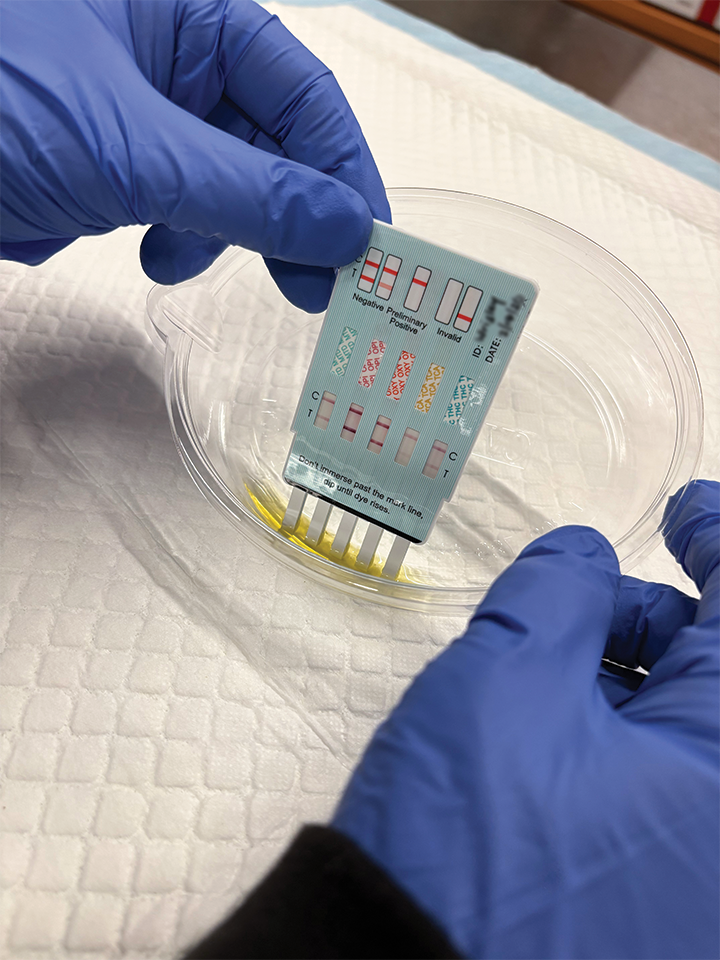
Figure 1. An over-the-counter urine drug test showing a urine specimen migrating up the card by capillary action.
How can veterinary staff determine if a urine drug test would be helpful for the development of a treatment plan?
Collecting a thorough patient history, including questions about the development and progression of clinical signs, is essential. Clinical staff should reiterate the importance of determining what caused a patient’s clinical signs to guide the diagnostic and treatment plan in a timely, cost-efficient way.
Detailed information about a patient’s home environment is needed to determine if a patient has been exposed to or ingested an intoxicant. While making it clear that improving the patient’s condition with expedient care is their primary concern, clinical staff should inquire about the presence of medications and drugs within the home and any other environment recently occupied by the patient. An effort should be made to ensure the client feels comfortable sharing information about their home environment, including the presence of any medications and drugs. These queries should be asked in private and in a nonjudgmental way to assure the client that it is safe to disclose this information regardless of the kind of drug or its legal status.
The clinical staff should explain to the client that urine drug tests are not validated for veterinary patients, yet they can be used to rapidly assess veterinary patients with clinical signs potentially caused by an intoxicating agent. Ultimately, a positive urine drug test result may provide greater certainty in the determination of appropriate treatment.
What clinical signs suggest drug intoxication?
Clinical signs that may indicate drug intoxication include excitation, tachycardia, ataxia, bradycardia, seizures, collapse, and coma.3 These clinical signs are nonspecific to intoxication and can be attributed to many diseases and disorders of the central nervous system.
Which drugs can be reliably identified by these tests using urine samples from veterinary patients?
These tests may not identify all intoxicants that a patient may have been exposed to or ingested. That is because veterinary patients metabolize some drugs differently than humans, and these tests are designed for humans. Reliable detection depends on the way a drug is metabolized. If the metabolite or calibrator excreted in the urine is the same as for humans, then the test is reliable for that veterinary patient.
Examples of drugs that may be identified in human urine samples by these tests include marijuana (THC [tetrahydrocannabinol]), opiates, amphetamines, cocaine, benzodiazepines, morphine, buprenorphine, MDMA (3,4-methylenedioxymethamphetamine), methadone, oxycodone, barbiturates, phencyclidine (PCP), dextropropoxyphene, and tricyclic antidepressants. (One Canadian company produces tests for 46 different substances.5) However, all of these substances are not reliably detected in veterinary patients by these tests.
Studies have found that OTC urine drug tests do not identify marijuana or methadone in urine samples from dogs known to have been exposed, which is suggestive of a difference in metabolism of these drugs between humans and dogs.6 One study aimed to detect and quantify canine marijuana metabolites using an ultraperformance liquid chromatography–tandem mass spectrometer.7 This study revealed that dogs do not produce consistent or detectable levels of the dominant metabolite (THC-COOH [11-nor-9-carboxy-Δ9-THC]) excreted by humans and measured by OTC urine drug tests. That is most likely the cause of frequent false negative tests for dogs known to have ingested marijuana. Fortunately, marijuana toxicity in dogs can be diagnosed with high specificity by veterinarians from a patient’s history and clinical abnormalities.8
Alternatively, some of these substances have the same metabolites in dogs as humans. For example, benzoylecgonine, the calibrator for cocaine, has been identified in urine samples from dogs with known cocaine exposure.9 Barbiturates, opiates, benzodiazepines, and amphetamines/methamphetamines have also been reliably detected in canine urine by these tests.7
Ultimately, a negative test result does not rule out exposure.
What can interfere with a urine drug test?
An adulterant is a substance that interferes with the results of a urine drug test. For example, the commonly used medication diphenhydramine may elicit a false positive for methadone, PCP, and opioids. Collecting a thorough history can help determine if an adulterant is affecting the test results. The ASPCA Animal Poison Control publishes a list of potential adulterants to consider for veterinary patients.10
Beyond a urine drug test, is there a way to confirm exposure or ingestion of an intoxicant?
Toxicology testing using blood or serum is available through specialized veterinary laboratories. The California Animal Health and Food Safety Lab System at University of California, Davis, College of Veterinary Medicine; Michigan State University Veterinary Diagnostic Laboratory; and Cornell University College of Veterinary Medicine Toxicology Laboratory are a few of the laboratories that can provide advanced toxicology testing.11-13 Specific instructions for submission requirements and expected wait times can be found on their websites.
What other resources can guide the clinical approach to a patient that may be intoxicated?
Animal poison control services can be a valuable resource, especially with the assessment of a patient and comparison to collected data from other similarly intoxicated patients.
Two available resources are ASPCA Poison Control and Pet Poison Helpline. These services can help interpret the results of diagnostics as well as guide treatment and decontamination efforts.
- You can use an over-the counter urine drug test as an inexpensive diagnostic to provide quick results without the need for advanced equipment.
- Collect a thorough patient history with inquiries about a patient’s home environment.
- Collect a urine sample from any patient with nonspecific clinical signs (e.g., ataxia, tachycardia, bradycardia, seizures, excitation, collapse, coma) suspicious of drug intoxication to ensure that an over-the counter urine drug test can be performed without interference.
- The package insert of a urine drug test contains specific instructions on how to perform the test and interpret the results; be aware that these instructions may be different for each test.
References
- VetLab drug testing kits. Package insert. Jorvet Supply; 2026.
- Prime Screen multi-panel urine test. Package insert. Prime Screen; 2022.
- Silverstein D, Hopper K. Small Animal Critical Care Medicine. 3rd ed. Elsevier Saunders. 2023;162:930
- Drugs of Abuse: A DEA Resource Guide. Published December 12, 2024. Accessed February 18, 2026. https://www.dea.gov/documents/2024/2024-12/2024-12-12/drugs-abuse-2024
- VeriCheck urine drug testing analytes. Accessed February 1, 2026. https://vericheck.ca/available-drugs/
- Teitler JB. Evaluation of a human on-site urine multidrug test for emergency use with dogs. JAAHA. 2009;45(2):59–66. doi:10.5326/0450059
- Fitzgerald AH, Zhang Y, Fritz S, et al. Detecting and quantifying marijuana metabolites in serum and urine of 19 dogs affected by marijuana toxicity. J Vet Diagn Invest. 2021;33(5):1002–1007. doi:10.1177/10406387211027227
- Loewen JM, Munn-Patterson ML, McEwen KE, Vuong S, Alcorn J, Chicoine AL. Analysis of cannabinoids in plasma from 38 cases of suspected cannabinoid intoxication in dogs. J Vet Emerg Crit Care. 2024;34:545–553. doi:10.1111/vec.13428
- Misra AL, Patel MN, Alluri VR, Mulé SJ, Nayak PK. Disposition and metabolism of [3H] cocaine in acutely and chronically treated dogs. Xenobiotica. 1976;6(9):537–552. doi:10.3109/00498257609151666
- Agents with potential to cause false positives in illicit urine drug screens. American Society for the Prevention of Cruelty to Animals. Accessed June 1, 2026. https://www.aspcapro.org/sites/default/files/2023-07/aspca-illiciturinedrugscreens.pdf
- California Animal Health and Food System Laboratory System. Updated Jun 5, 2026. Accessed June 13, 2026. https://cahfs.vetmed.ucdavis.edu/
- Michigan State University Veterinary Diagnostic Laboratory. Accessed June 13, 2026. https://cvm.msu.edu/vdl/laboratory-sections/toxicology,
- Cornell University College of Veterinary Medicine Toxicology Laboratory. Accessed June 13, 2026. https://www.vet.cornell.edu/animal-health-diagnostic-center/testing-laboratories/toxicology