
Reading CBCs of a zebra shark? Check. Setting up a mobile ultrasound on a dolphin? No sweat. Helping people understand the value of ocean conservation? That’s one part of the role Lexi Nix, CVT, was not expecting when she started as a veterinary technician at Shedd Aquarium in Chicago.
Every day, veterinary nurses/technicians make a positive impact on their clients, patients, coworkers, and greater community. But the stories behind each and every one of these professionals are often overlooked due to the selfless nature of working in veterinary medicine. Today’s Veterinary Nurse aims to shine a light on some of these stories with its Clinic Champions series. Each issue, TVN will honor a veterinary nurse for their contributions in community service, scholarship, advocacy, or innovation. This series will highlight unsung heroes who make a lasting impact on their patients and community. At the end of the year, 1 of the 4 honorees will be recognized as the Clinic Champion of the Year. Nominate a Clinic Champion today!
“In small animal medicine, you’re educating clients, but a big part of this job is telling these animals’ stories,” says Nix. “When people come through our doors, they might come face to face with a penguin, or meet our sea lions, or see how big a sunflower sea star is up close. There is a palpable connection that you can feel, and they’re inspired by these stories. They want to know how they can help.
“When you’re able to have those conversations or witness these interactions happening—these are small moments, but they are some of the most significant moments in my career.”
That’s a connection that Nix understands. Originally a marine science major in college, she uncovered her interest in veterinary medicine on a visit to a zoo in Lima, Peru. She was fascinated by seeing the veterinary team establishing baseline blood values in their Humboldt penguins and comparing those with the local wild population.
“That was my first time really seeing how a veterinary team works, but also how a veterinary hospital in a zoo can help conservation for animals in the wild as well. I fell in love with it,” says Nix.
With the encouragement from a friend, Nix shifted paths to veterinary technician school. She landed an externship at Shedd Aquarium, one of the world’s largest aquariums and home to tens of thousands of animals. After gaining experience studying abroad, working at small animal emergency facilities, and spending 2 years volunteering at Shedd, Nix earned a full-time position as a veterinary technician.
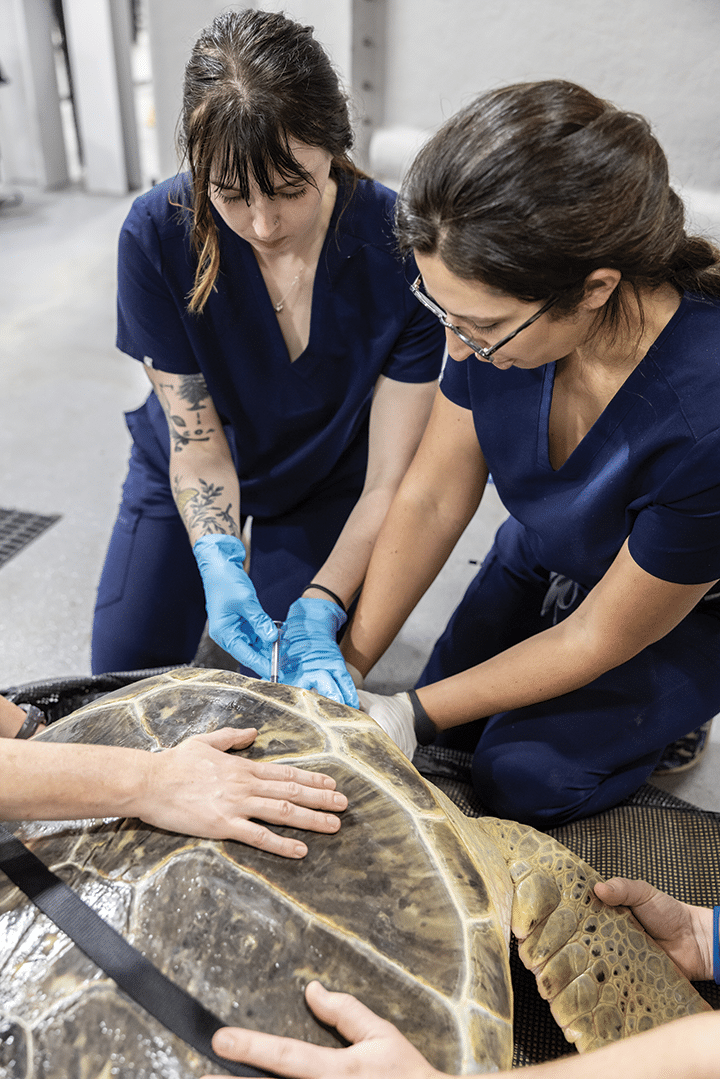
On the Move – Shedd Aquarium has a full on-site veterinary facility, but Lexi Nix and the veterinary team (seen above with a sea turtle) often have to go mobile for check-ins and treatments. Courtesy ©Shedd Aquarium/Brenna Hernandez
While she plays a vital role in caring for the animals at the aquarium, Nix is also able to explore her passion for conservation through fieldwork. Shedd Aquarium offers opportunities to participate in conservation, rescue, and rehabilitation trips, which have allowed Nix to work with Magellanic penguins in Patagonia and pinnipeds at the Channel Islands Marine and Wildlife Institute in Southern California.
We spoke with Nix about the ins and outs of her daily work, the challenge of caring for a wide variety of species, and more.
TVN: What does a day at work look like for you?
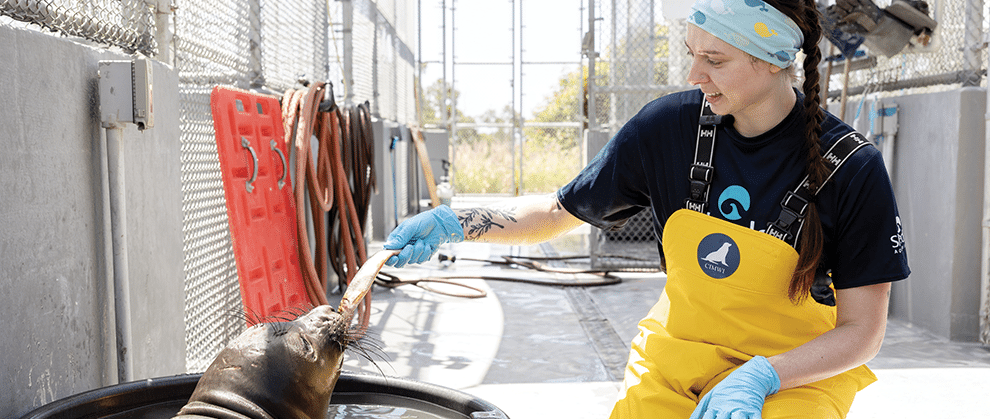
Nix: Every day is so different. Typically, in the mornings, we’ll start with procedures. Those can be routine exams—whether they need blood work, x-rays, some of them get CTs and things like that. Especially if it’s anesthesia, we want to start that off in our morning, and then later on, we might do treatments, where we go to the animal. That might be, for example, if an animal or a fish isn’t eating, we might give it an assist feed or a scheduled dose of antibiotics. A major part of working at an aquarium is being mobile, so a lot of times we are going to the animal. You have to be flexible in that way, because our belugas or our sea lions, they can’t walk up to the animal hospital. So, we work really closely with these animals and our animal care specialists on what we call “voluntary medical behaviors” so when we need to intervene, it is in a safe environment for the animal and animal care staff. An example of that: If we need ultrasonography or blood work on our dolphins or belugas, we can ask them for that behavior. Or if our sea otters or sea lions have an upset stomach, we can ask them for an x-ray behavior. These are behaviors that we work to train so they know what the ultrasound looks like. They know what the ultrasound probe does. Or when they see our x-ray machine—it’s a big, giant yellow generator—they’re not going to be scared. It’s really cool to see these bonds and these close relationships. And it also gives them a say in their own health care as well.
TVN: How do those “command behaviors” work?
Nix: If we go down to our belugas or dolphins for an ultrasound—whether it is a new concern or routine monitoring—their trainers will ask for that command. We call it a layout. They can either do that command and float to the top on their side—the trainer will tell us if they did it properly and we can go on with the ultrasound—or they can simply zoom away and say, “I don’t want to do ultrasound right now.” There are steps with that. Some whales, dolphins, or any animal, might be more nervous. The first step is having them sit next to the trainer and they see the ultrasound or x-ray equipment. As they get used to that, we’ll slowly increase it. So, we might place the ultrasound in the water turned off, and then once they get used to that, we might turn it on. It’s a step-by-step process until they get comfortable with that behavior.
TVN: What are the most common procedures or care you provide?
Nix: If it’s a simple routine exam, no matter what the animal is—if it’s a frog, a shark, a fish, sea lion or a beluga—our approach to handle these exams is the same. No animal is receiving better health care than the other. One of the things that could be a challenge, but I also find really exciting about this field, is that it is so different. Sometimes you might be presented with a problem that you never thought you’d have to answer. If we have an anaconda that needs to be nebulized, how are you safely and effectively going to do that? I can’t go on Google and search “anaconda nebulizer.” Those scenarios require you to be adaptable. Of course, we also have routine preventive exams, which include routine monitoring to make sure that all of our animals are still healthy and their organs are functioning properly.
TVN: Does working with such a wide range of species present a challenge or do these animals have more in common than it seems?
Nix: It is definitely a challenge. You need to know how the body of each species works, and even if you’re just looking at sharks versus fish, those are also different in every aspect. Some medications are toxic to one species but not to others. Vet techs are also working on the labs, reading blood smears. Even species to species, if you take a hawk or a parrot, their blood cells look completely different. There is a big learning curve with that. But I do think our clinical skills can transfer. What I mean by that is, if you can draw blood on a dog or do anesthesia on a cat, that can transfer to birds, fish, sharks. Those skills are transferable, but the anatomy and physiology are definitely things that you do need to learn.
TVN: What is the veterinary facility like behind the scenes at the aquarium?
Nix: We have a treatment room with 2 tables where we will typically do exams. We also have an x-ray and a pharmacy wall in that area. And then we have a separate surgical prep room where we sterilize all of our equipment. And then we also have a separate surgery suite. It is pretty big, but we do have to be adaptable and mobile. So, we have what we call mini ambulance carts that we can push around the aquarium, and it’s basically one big entire hospital shrunk down into a cart.
TVN: What are some clinical skills that you really developed as you got more experience in this job?
Nix: Reading CBCs. You’re taught that in school, but you’re taught on dogs and cats or your pocket pets that you can get at pet stores. There is not really a lab that is going to read sharks or fish, and there’s also not a lot of validated resources on these. Every fish and every shark will also have different blood cells, and their cells are so different. A big skill set that I learned here is being able to identify what those red blood cells look like and tell apart all the different white blood cell counts. Every time we get blood on a fish or a shark, we are reading those in-house, and that is something that all of our technicians here are skilled at and are taught when they get here.
TVN: What would be your advice for someone who’s interested in pursuing this field on how to get started?
Nix: Don’t get discouraged if you don’t have any aquatic skills. A lot of that is taught on the job. I would recommend volunteering at a local wildlife rescuing rehab center or an aquarium. And then another skill set that is used in aquariums or even wildlife centers is that emergency skill set. If there’s an emergency/critical care or ICU center near you, that would be great experience to have as well.
There is also the Association of Zoological Veterinary Technicians. You can join them, and they have constant job postings and a Facebook group where a lot of aspiring veterinary technicians will ask questions. There is also a conference every year where you can go to network and meet some more people in the field.