

Forensic veterinary medicine refers to the use of animal health principles, forensic science applications, and legal expertise to help achieve justice in court when animals are the victims of a crime. Through the presentation of valid, timely, and properly preserved scientific evidence in legal proceedings, forensic veterinary medicine seeks to investigate and resolve cases involving animal cruelty, abandonment, neglect, non-accidental injuries, poisoning, animal fighting, firearm and sharp-force trauma, suspicious deaths, large-scale hoarding cases, wildlife crimes, and other violations of animal welfare laws.
In forensic veterinary medicine cases, more emphasis is traditionally placed on the veterinarian’s role than on the veterinary nurse’s, even though the veterinary nurse’s contributions to forensic case management have been recognized.1 However, little has been written about how impactful the participation of these personnel can and should be in helping to resolve cases where forensic medical expertise is timely and necessary. This article will explore the various contributions veterinary nurses can make in this growing and increasingly important area of the field.
The Veterinary Nurse’s Role
The veterinary nurse can be a key figure in the integrity of a forensic case by facilitating the documentation of collected evidence, properly handling case samples, and communicating their observations as a witness to the events, among other related tasks. It is emphasized that, generally, the expert witness will be a veterinarian given their academic background and experience.The veterinary nurse could fulfill the role of a factual witness given their credentials.The former may offer expert opinions based on specialized knowledge, while the latter may testify only about facts and observations they personally witnessed.
Forensic Necropsy
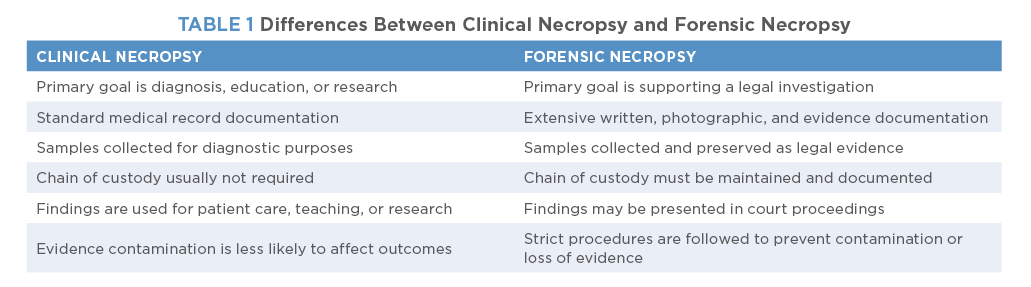
Just as in a clinical necropsy, which may have medical and/or educational purposes and in which the veterinary nurse plays a significant role, the same can be true in a forensic necropsy (TABLE 1).2 Forensic necropsy has a legal objective, and therefore generally requires stricter procedures in which the veterinary nurse may also participate.These may include maintaining chain of custody records, comprehensive photographic documentation, meticulous evidence labeling and packaging, contamination prevention measures, and detailed written reports that may later be scrutinized in court. Veterinary nurses can play a critical role in many of these procedures.
When performing forensic necropsy, the veterinary nurse may actively participate in preparing the area where the necropsy will be performed, ensuring the biosafety of all participants and the proper collection, handling, and preservation of any tissues that may be collected. Furthermore, they can be responsible for identifying and organizing all the forensic instruments and materials that may be needed. The use of metric scales (ruler or tape measure) and markers, which facilitate the documentation of the actual size of an injury, wound, or affected organ, may also be the responsibility of the veterinary nurse when performing forensic necropsies.Additional equipment commonly used includes digital cameras with high-resolution imaging capabilities, specimen collection kits, evidence bags and containers, tamper-evident seals, personal protective equipment (PPE), labels and chain-of-custody forms, and materials for collecting trace evidence such as hair, fibers, soil, or biological samples.
Cadaver Handling
One of the primary responsibilities of the veterinary nurse in forensic cases is the proper handling of the cadaver to avoid contamination of the samples to be collected. The entire body or only parts of it may be used as evidence in a case, and it is the veterinary nurse’s responsibility to ensure the integrity and preservation of the body from contamination from the outset. This includes preventing contamination, maintaining proper storage conditions, accurately labeling specimens, documenting the chain of custody, and limiting handling of the remains to authorized personnel.
Of course, the veterinary nurse must be aware of the risks involved in participating in forensic necropsies, such as potential exposure to zoonotic, chemical, or decomposing agents, and the handling of hazardous materials.3 For this reason, the use of appropriate PPE is essential to ensure both personnel safety and evidence integrity. Commonly used PPE includes disposable gloves (often changed between evidence collection steps), fluid-resistant gowns or coveralls, shoe covers, face masks or respirators, eye protection, and hair covers. These measures help minimize contamination, preserve trace evidence, and maintain the evidentiary value of the remains.
Chain of Custody
A critical topic that is generally not discussed in the technical training of veterinary nurses is the use and application of the chain of custody for evidence in each case. This chain of custody is defined as the chronological documentation that tracks the history, handling, and transfer of forensic evidence from the moment of collection to its presentation in court.4 This record ensures the integrity, authenticity, and validity of evidence from the moment it is collected until it is presented in a legal proceeding.
The veterinary nurse can play a significant role in preserving this chain. For example, if a biological sample is collected in a veterinary criminal case, the veterinary nurse can document who collected it, properly label it, record its transfer to different facilities such as laboratories for analysis and storage areas, and note all individuals who handle the sample. The veterinary nurse (and anyone else involved in the case) must recognize that any break or alteration in the chain of custody could have legal repercussions,4 potentially leading to the dismissal of the evidence in court, even if that sample is a key and essential piece in proving the guilt or innocence of the accused. Therefore, by safeguarding the integrity of the chain of custody, the veterinary nurse not only assists in the process but also protects the legal validity of the case.
Written Documentation
In many complex cases, it would be virtually impossible for a veterinarian to thoroughly examine complex scenes involving multiple animals on their own while simultaneously recording their observations accurately for later reference in their forensic report. In such cases, the veterinary nurse becomes crucial, acting as a scribe for all of the veterinarian’s observations as they assess the areas where the animals were located.5 These areas might include large barns and extensive farms, as well as large numbers of animals. Attention to detail is essential for recording all of the veterinarian’s comments and observations.
Furthermore, the veterinary nurse will also be able to make a detailed and objective record of their own findings, always using descriptive rather than interpretive language.2 Interpretation is the responsibility of the veterinarian as the expert witness in these cases. For example, noting “infected wound on hind limb” is not the same as “ulcerative lesion 3 cm in diameter on the lateral aspect of the right hind limb, with irregular borders and visible purulent exudate.” Therefore, the veterinary nurse must have a rigorous command of the appropriate medical terminology.
Additionally, the use of body diagrams, as well as standardized forms, whether self-created or recommended and/or used by other experts, could greatly facilitate this work. Examples include injury-mapping forms, necropsy examination worksheets, body condition scoring charts, evidence logs, and chain-of-custody forms, all of which help ensure accurate and consistent documentation.
Photographic Documentation
The veterinary nurse can effectively participate in photographing the scenes, the animals, and the necropsy procedures being performed. They must always adhere to the basic principles of photography, including lighting, focus, and appropriate scale, to facilitate accurate visual documentation.
To this end, veterinary nurses must always ensure they take 3 appropriate views of the area to be photographed. The first should be a full-body shot to properly identify the victim, followed by a midrange shot that identifies the general area of the body where the injury or wound is located, and finally, a close-up of the injuries or wounds to facilitate seeing the details of the findings.
These photographs must be captured and stored according to established forensic protocols. Dedicated cameras are often preferred because they help ensure consistent image quality, proper evidence handling, secure storage, and appropriate chain-of-custody documentation for legal proceedings. Occasionally, the parties involved in the cases may request an inspection of the equipment used.
Court Witnesses
A powerful yet underexplored contribution of the veterinary nurse in forensic medicine is their role as court witnesses.7 In this case, the veterinary nurse can participate as a factual witness; as mentioned previously, only a veterinarian can participate as an expert witness. Since veterinary nurses generally do not receive academic training to appear in court, they must ensure they are adequately prepared to testify only to what they observed without any interpretive intent. Likely, the expert witness (i.e., the veterinarian) will later provide the necessary interpretations. The veterinary nurse’s testimony should be based on documentation they themselves generated and on their own observations. Of course, they must also prepare adequately for cross-examination, which, depending on the case, could be very direct and incisive.
Other Considerations
Other areas in which veterinary nurses could be involved include the handling and preservation of biological evidence,1 interaction with law enforcement agencies,8 and the ethical dilemmas and emotional effects that such responsibilities may have on individuals.9 Individuals interested in this branch of veterinary medicine must develop the necessary skills and techniques, including both technical competencies and emotional resilience. Because forensic cases often involve animal cruelty, neglect, and traumatic injuries, veterinary personnel must be able to maintain objectivity, professionalism, and attention to detail while coping with potentially distressing situations. In addition, veterinary nurses should take related continuing education courses and complete emerging certifications in these areas (BOX 1). This presents a significant opportunity for growth for academic programs responsible for training veterinary nurses.10
- International Veterinary Forensic Sciences Association (IVFSA)
- International Society for Animal Forensic Sciences
- American Veterinary Medical Association (AVMA)
- National Link Coalition
- Veterinary Forensic Investigations, LLC
Recommended Continuing Education Topics
- Veterinary forensic pathology
- Animal cruelty investigations
- Crime scene processing and documentation
- Evidence collection and preservation
- Chain-of-custody procedures
- Forensic photography
- Expert witness preparation and courtroom testimony
- Wildlife crime investigations
Recommended Training Areas for Veterinary Nurses
- Forensic necropsy assistance
- Injury documentation and body mapping
- Evidence handling and packaging
- Trace evidence collection
- Report writing for legal proceedings
- Compassion fatigue, resilience, and mental wellness
Recommended References
- Merck MD. Veterinary Forensics: Animal Cruelty Investigations. 2nd ed. Wiley-Blackwell; 2013.
- Rogers E, Stern AW. Veterinary forensics: Investigation, Evidence Collection, and Expert Testimony. CRC Press; 2018.
Summary
Veterinary nurses can be invaluable in conducting forensic investigations. Their participation has proven to be both necessary and timely. Therefore, there is a need for greater recognition and training for these professionals in this area of veterinary knowledge, as their contributions can have a significant impact on both animal welfare and the administration of justice.11
References
- Bradley-Siemens N. General principles of veterinary forensic sciences and medicine. In: Byrd JH, Norris P, Bradley-Siemens N, eds. Veterinary forensic medicine and forensic sciences. CRC Press; 2020:21-34. https://doi.org/10.4324/9781315121918
- Samples OM, Echols MS. Necropsy: A technician’s role. In: Samples OM, Echols MS, eds. Laboratory manual for clinical veterinary technology. Teton NewMedia; 2022:175-192. https://doi.org/10.1201/9781003330967
- Performing a necropsy. AAHA. July 18, 2024. Accessed August 12, 2026. https://www.aaha.org/resources/2018-aaha-infection-control-prevention-and-biosecurity-guidelines/performing-a-necropsy/
- Mbagwu I, Nwabudo O, Oyama. Forensic evidence management: chain of custody process. IJAAFMR. 2025;9(6):232-245.
- Dzikowski A. Veterinary expert: legal nature and responsibility. Animals (Basel). 2023;13(13):2163. doi:10.3390/ani13132163
- Digital evidence policies and procedures manual. National Institute of Justice. May 1, 2020. Accessed August 12, 2026. https://nij.ojp.gov/library/publications/digital-evidence-policies-and-procedures-manual
- ASPCA Veterinary Forensic Science Center (AVFSC). ASPCApro. October 21, 2020. Accessed August 12, 2026. https://www.aspcapro.org/about-programs-services/aspca-veterinary-forensic-science-center-avfsc
- Forensic investigations. ASPCA. Accessed August 12, 2026. https://www.aspca.org/investigations-rescue/forensic-investigations
- Peterson NW, Foltz K, Moses L, Boyd JW. Veterinary technicians report in a survey how futile veterinary treatments contribute to their moral distress and impact their professional and personal lives. JAVMA. 2025;263(4):473-482. doi:10.2460/javma.24.10.0659
- Ferrell E. Professional training in veterinary forensic sciences accessible within the curricula of 30 veterinary medical colleges in the United States: why training must increase. Journal of Veterinary Forensic Sciences. 2020;1(2):26-31. https://doi.org/10.32473/jvfs.v1i2.128749
- AAVSB veterinary team survey: understanding the results. AAVSB. Accessed August 12, 2026. https://www.aavsb.org/wp-content/uploads/2026/02/AAVSB-Veterinary-Team-Survey_-Understanding-the-Results_Updated-Who-We-Are-Section.pdf